
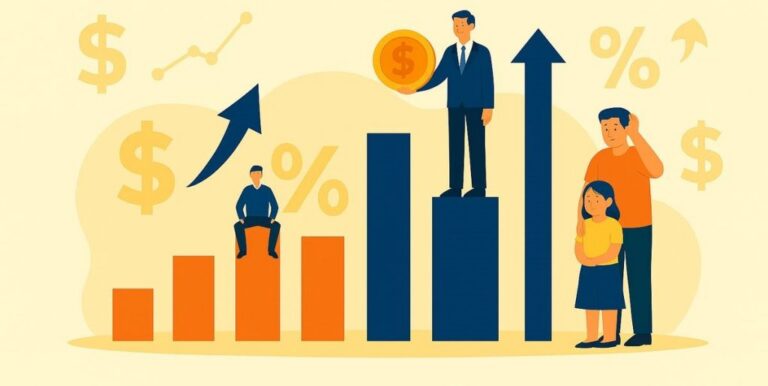
The American Dream has long symbolized opportunity—the belief that hard work and determination can lead to prosperity. Yet, for many households, that dream feels increasingly out of reach. Over the past decade, the gap between the wealthy and the working class has grown wider, altering the financial landscape for millions of families.
For most Americans, managing finances has become a balancing act between survival and aspiration. As high-income earners accumulate wealth through investments and property, middle- and lower-income families often struggle to cover basic needs or build savings. This divide doesn’t just affect individuals—it influences the broader economy, shaping everything from consumer spending patterns to social mobility and long-term growth.
The roots of income inequality

Income inequality in the United States didn’t appear overnight. It’s the result of decades of economic shifts, policy decisions, and technological transformations. The decline of manufacturing jobs, the rise of automation, and the growing dominance of high-skill industries have created a labor market that rewards specialized education while leaving many behind.
Tax policies and corporate structures have also contributed to the imbalance. Capital gains and investment income, which benefit the wealthy, are often taxed at lower rates than wages. Meanwhile, the cost of living—especially housing, healthcare, and childcare—continues to rise faster than most people’s paychecks. For many families, this means that even with full-time work, financial security remains elusive.
The role of education and access
Education remains one of the strongest predictors of financial success, yet access to quality schooling is deeply unequal across the country. Wealthier communities often enjoy well-funded public schools and resources that prepare students for higher education and competitive careers. In contrast, underfunded districts struggle to provide even basic materials, perpetuating cycles of poverty.
College debt adds another layer of challenge. Young adults from middle- and lower-income families often take on substantial loans to earn degrees, delaying milestones like homeownership or family planning. Without targeted policies to make education more affordable, the gap between the “haves” and “have-nots” will only continue to widen.
The ripple effect on households and the economy
Income inequality affects more than individual bank accounts—it influences the entire economic system. When wealth concentrates among a small segment of the population, consumer spending weakens because middle- and lower-income households have less disposable income. This imbalance slows economic growth, as fewer people can afford to invest, start businesses, or purchase homes.
On a personal level, inequality manifests as stress and instability. Families living paycheck to paycheck face constant uncertainty about emergencies—whether it’s a car repair, a medical bill, or a job loss. Over time, this financial strain erodes well-being and mental health, creating ripple effects that reach far beyond the household.
The changing face of the American middle class
Once seen as the backbone of the U.S. economy, the middle class is shrinking. Rising costs of living and wage stagnation have made it harder for families to maintain the same standard of living their parents enjoyed. Essentials like housing and healthcare now consume a greater share of income, leaving less room for savings or leisure.
Despite these challenges, the resilience of American families remains strong. Many are adapting by embracing side hustles, remote work, and new forms of entrepreneurship. While these efforts offer short-term relief, they can’t fully compensate for systemic disparities that require broader economic reform.
Toward a more balanced future
Addressing income inequality will require coordinated action—through fairer tax systems, better access to education, and policies that prioritize working families. Strengthening social safety nets and ensuring equal opportunities can help rebuild the middle class and restore confidence in the economy.
Ultimately, narrowing the wealth gap isn’t just about redistributing income—it’s about restoring dignity, opportunity, and hope. When every household has a fair chance to thrive, the entire nation benefits. A more balanced economy isn’t only possible—it’s essential for a stronger, more unified America.